Showing posts sorted by relevance for query pierre schaeffer. Sort by date Show all posts

Thursday, April 21, 2016

Sound Art Pierre Schaeffer I


Pierre Schaeffer: an interview with the pioneer of musique concrete

by Tim Hodgkinson, 2 apr 1986


Introduction: What is Musique Concrete and why is it so important today?

Musique Concrete is music made of raw sounds: thunderstorms, steam-engines, waterfalls, steel foundries... The sounds are not produced by traditional acoustic musical instruments. They are captured on tape (originally, before tape, on disk) and manipulated to form sound-structures.

The work method is therefore empirical. It starts from the concrete sounds and moves towards a structure. In contrast, traditional classical music starts from an abstract musical schema. This is then notated and only expressed in concrete sound as a last stage, when it is performed.


Musique Concrete emerged in Paris in 1948 at the RTF (Radio Television Francais). Its originator, leading researcher and articulate spokesman was Pierre Schaeffer - at that time working as an electro-acoustic engineer with the RTF.

Almost immediately, Musique Concrete found itself locked in mortal combat not only with its opponents within traditionally notated music, but also with Electronic Music, which emerged in Cologne in 1950 at the NWDR (Nord West Deutscher Rundfunk). Electronic Music involved the use of precisely controllable electronic equipment to generate the sound material - for example, the oscillator, which can produce any desired wave-form, which can then be shaped, modulated, etc...


At the time, the antagonism between Musique Concrete and Electronic music seemed to revolve largely around the difference in sound material. Over the decades, this difference has become less important, so that what we now call 'Electroacoustic Music' is less concerned with the origin of the sound material than with what is done with it afterwards.

The real difference, the most lasting difference, between Musique Concrete and Electronic revolves around a basic disagreement as to the nature of the whole project. For Musique Concrete, the essential character of music as a human activity is such that the listening experience and the 'ear' are crucial things. For Electronic Music, the priority is the idea, the system, the perfection of control, of precise rationalization... to become scientific...


And what is the situation today? [1986] We can say unequivocally that whole areas of music - indeed, of aesthetic, humanist activity in general - have been hived off to the scientific establishment with its vast industrial and political power. Look at France today, with its megabuck prestige science-music research centre IRCAM (Institut de recherche et coordination acoustique/musique) situated underground next to the Beauborg. The concatenation of state power, the technocrat elite, the production and consumption of an irrational surplus technology, the corridors littered with last month's computers - all this clearly testifies that the French state takes its music seriously enough to embrace it in a kind of mutual death-pact of technicization...


And this, in a nut-shell, is why Musique Concrete is important today; because the opportunity is still there to use all the parameters of sound and still make music and not pseudo-science...
Interview (2.5.86)


Pierre Schaeffer: born Nancy, France in 1910. Developed a wide range of interests in poetics, technics and philosophy. Became famous in the late '40s when, working as a broadcast engineer for the Radio-Television Francaise, he formulated the ideas and techniques of Musique Concrete and founded a studio for tape composition. Collaborated with Pierre Henry on several of the classic compositions in the genre, including Symphonie pour un homme seul and the first Concrete opera, Orphee, staged at Donaueschingen in 1953. In the last two decades he has concentrated on his work as a writer and commentator on the state of western culture.


Tim Hodgkinson: born 1949. Studied social anthropology. Engaged in a wide range of musical work - Henry Cow, 1968-78; The Work, 1980-82; and numerous other projects since. Currently composing for orchestra and working on a general theory of music.

The interview was conducted in French at the house of M. Schaeffer and translated by Tim.


TH: You are a writer, a thinker, and a radio sound-engineer. This makes you, from the point of view of 'Music' with a capital 'M' - something of an outsider. Do you think that, in moments of crisis, the non-specialist has a particular and important role to play? I don't know whether this is entirely correct, but I sense that, at the moment when you came into music, around 1948, you were a non-specialist of this kind...

PS: Yes. But chance alone doesn't explain why a non-specialist gets involved in an area he doesn't know about. In my case there were double circumstances. First of all, I'm not completely unknowledgeable about music, because I come from a family of musicians: my father was a violinist and my mother was a singer. I did study well - theory, piano, cello, etc, so I'm not completely untrained. Secondly, I was an electroacoustic engineer working for the French radio, so I was led to study sound and what's called 'high fidelity' in sound. Thirdly, after the war, in the '45 to '48 period, we had driven back the German invasion but we hadn't driven back the invasion of Austrian music, 12-tone music. We had liberated ourselves politically, but music was still under an occupying foreign power, the music of the Vienna school.


So these were the three circumstances that compelled me to experiment in music: I was involved in music; I was working with turntables (then with tape-recorders); I was horrified by modern 12-tone music. I said to myself, 'Maybe I can find something different... maybe salvation, liberation, is possible.' Seeing that no-one knew what to do anymore with DoReMi, maybe we had to look outside that... Unfortunately it took me forty years to conclude that nothing is possible outside DoReMi... In other words, I wasted my life.


The first piece of "musique concrete," composed by Pierre Schaeffer in 1948 out of sounds produced by trains.

TH: We'll certainly have to come back to that. Right now, I want to ask you if you think that there is an inherent connection between what seem to be simultaneous developments; that, on the one hand, there is the crisis of traditional music - 12-tone and so forth - and on the other, there are the new possibilities offered by technology, possibilities of opening up new continents of sound. Sometimes this seems to me to be merely a matter of luck. At other times it seems that there must be an inherent reason...

PS: I would answer that this luck is deceptive. First, it doesn't surprise me that traditional music has experienced a kind of exhaustion in the 20th century - not forgetting that many musicians started to look outside the traditional structures of tonality. Debussy was looking at 6 note scales, Bartok was exploring mode; tonality seemed to be exhausted.The impressionists, Debussy, Faure, in France, did take a few steps forward. Then, after the impressionists, we have a period of rigour, of barbarity, a period seeking to re-establish something more solid. This is epitomised in the Vienna school. At this point the Vienna school was also inspired by scientific ideas, by a rigour coming from a discipline which wasn't music but an algebraic equation.


François Bayle, Pierre Schaeffer, Bernard Parmegiani at GRM in Paris, 1972

So it seems that one of two things can happen in a period of high technology; either, technology itself seems to come to the rescue of art - which is in a state of collapse - (that was my starting point, Musique Concrete with the tape-recorder, now electronic music, etc), or it's the ideas of technology, ideas from mathematics, ideas with a scientific aura, or real scientific ideas given an unreal relevance to an art which is seeking its discipline - its ordering principles - outside itself instead of within the source of its own inspiration. This coincidence of a music which is debilitated and failing and a glorious, all-conquering science is what really characterizes the 20th century condition.


Marshall McLuhan et Pierre Schaeffer (INA, 1973)


What did I try to do, in this context, in 1948? As Boulez said, extremely snidely (he's a pretentious boy, a kind of musical Stalinist... I'm an anarchist myself), it was a case of 'bricolage'. (Note: This French noun has no direct equivalent in English, but is close to the adjective 'makeshift'; and the idea of improvising new uses for things originally meant for something else) I retain this term not as an insult but as something very interesting. After all, how did music originate? Through bricolage, with calabashes, with fibres, as in Africa. (I'm familiar with African instruments). Then people made violin strings out of the intestines of cats. And of course the tempered scale is a compromise and also a bricolage. And this bricolage, which is the development of music, is a process that is shaped by the human, the human ear, and not the machine, the mathematical system.


TH: It seems to me that there are several possible attitudes to the machine. There is something which we can trace to a kind of puritan tradition, where the machine represents a kind of purification, or perfection, which we in ourselves cannot achieve, and is therefore an escape from the human. Then there is another point of view which retains a humanist perspective and sometimes a kind of projection of human qualities onto the machine, and which is in any case a more complex and a more doubting relationship... I would place the Futurists, for example, in this second point of view. Looking at the history of Musique Concrete, there sometimes seems to be a symmetry, with sound on one side and system on the other, with Musique Concrete taking the side of sound. Within this duality, would you agree that Musique Concrete embodies a more humanist position?

PS: Yes, of course. You mention symmetry, and I would like to take this term as a very good way of looking at this. But what symmetry? I think we are speaking of a symmetry between the sound world and the music world. The sound world is natural -- in the sense where this includes sound made by sound-producing instruments -- the Rumori generators, Concrete, etc. -- the sound of the voice, the sounds of nature, of wind and thunder, and so forth. So there is, within the human ear, as it developed over millions of years, a great capacity for hearing all this sound. Sound is the vocabulary of nature. When we hear the wind, the wind says 'I'm blowing'. When we hear water, the water says 'I'm running'... and so forth. Noises have generally been thought of as indistinct, but this is not true. In the 17th century people thought of noises as unpleasant -- but noises are as well articulated as the words in a dictionary. Opposing this world of sound is the world of music, the world of musical entities, of what I have called 'musical objects'. These occur when sounds bear musical value. Take a sound from whatever source, a note on a violin, a scream, a moan, a creaking door, and there is always this symmetry between the sound basis, which is complex and has numerous characteristics which emerge through a process of comparison within our perception. If you hear a door creak and a cat mew, you can start to compare them -- perhaps by duration, or by pitch, or by timbre. Thus, whilst we are used to hearing sounds by reference to their instrumental causes, the sound-producing bodies, we are used to hearing musical sounds for their musical value. We give the same value to sounds emanating from quite different sources. So the process of compaaring a cat's mew to a door creak is different from the process of comparing a violin note to a trumpet note, where you might say they have the same pitch and duration but different timbre. This is the symmetry between the world of sound and the world of musical values.


TH: What is musical value for you exactly?

PS: The best analogy is with language -- since we talk of musical languages. People who share the same language, French or Chinese or whatever, have the same vocal cords and emit sounds which are basically the same, as they come from the same throats and lungs. So this is a sound world. But the same sounds have linguistic values and this makes them different. These linguistic values derive from their role within a system. In the same way, musical value is inseparable from the idea of system.

But how does this bear on the question of the machine in our contemporary world -- which is really a different question from the question of symmetry? We could say that the machine has had two quite different, even antagonistic, impacts on our modern world. There is the romantic, romanesque, illusionist tendency which proposes a biology of the machine, which is rather what the Italians (Futurists) were about; it goes back to the storms and the murmuring forests of romanticism, the pastoral symphony, the representation of nature in music.

But of course as machines now constitute nature, music now needs machines to represent this nature; our forests and countrysides _are_ machines... But there is another, quite opposite, tendency, which sees machines as the means not only of producing sound but also of musical values themselves. Many researchers, well understanding the pre-eminent importance of musical value, turned to the physicists. Their values were now frequencies, decibles, harmonic spectra. With electronics they could get direct access to all this and have really precise and objective musical values. But then -- another symmetry, this time a really disturbing one.

When you build a farcical machine for rumori with things rubbing against each other -- like the Italians -- lead shot in a d rum, etc, you don't hurt a fly, it lasts 10, 20 years -- it's circus, quite harmless little sound effects. But when you stick generations of young musicians, as is happening today, in front of synthesisers -- I don't mean the ones for commercial music, but the really precise ones, where you have one control for the frequency, another for the decibels, another for the harmonic spectrum -- then you're really in the shit... [Laughter]


TH: What then should one want to do with music? Accepting the need for musical values is one thing, but how do you choose?

PS: You have to remind musicians of what Dante wrote over the Gates of Hell: Abandon hope all ye who enter here...


TH: But if you stay outside?

PS: Well then you don't have any music. If you enter, if you want to make music, you must abandon hope. Of what? Of making a new music.

from recommended records quarterly magazine, volume 2, number 1, 1987


 MORE in PREPARED GUITAR
Sound Aesthetics: Xenakis (January 7, 2016)
Pinhas Deleuze Sound language (January 21, 2016)
Angle(s) VI John Cage (April 30, 2015)
Morton Feldman (March 16, 2015)
Morton Feldman and painting (October 3, 2014)


Friday, April 29, 2016

Sound Art Pierre Henry


Interview by Iara Lee for Modulations


As you could tell by the name, music concrete is a French concoction- one of its pioneers is composer Pierre Henry. Along with Pierre Schaeffer, Henry took sounds and manipulated, re-arranged and recontextualized them. In one brilliant piece, Henry took a squeaky door and a person sighing and turned these into saxophones, bells, laughter, gongs, wind gushes and other unidentifiable noises. After creating his early revolutionary work with Shaeffer in a state sponsored studio, Henry went to work on his own studio in the late '50's, further exploring this medium, which continues even now. Today, Henry's work with sound manipulation is what we usually think of as sampling. His works have included the very moving "Voile d'Orphee" (1953) (where sound sources become meditative orchestras and choirs), the above mentioned "Variations pour une Porte et un Soupir" (1963), "Le Voyage" (1961-63, based on the Tibetan Book of the Dead) and more recently "A La Recherche..." (a radio play based on a Proust work) and "Le Livre des Morts Egyptien" (1990). His work has also included assorted collaborations with poets, dancers, film makers and rock bands (Ceremony with Spooky Tooth, 1968), not to mention his foray into popular music with Yper Sound ("Psyche Rock", 1964).


Q: What time or period do you consider music concrete to be rooted in?
Concrete music is not a music of today nor of yesterday. It comes from a long way off. Many composers, artists, writers, painters imagined that one day music would transform itself into a vast opera of new sounds, unprecedented sounds, sounds that have never been heard of.
As a child, my head was filled with new sounds, sounds that couldn't be interpreted. And that is the peculiarity of concrete music. It resides in the fact that it doesn't come from interpretation nor performance. Thus imagination is the core of concrete music. And this imagination is linked to a technique, to a way of doing. So the first would be that concrete music is a music that is done differently. It's the fabrication of music and not only fabrication but also its conception and its composition.


Q: What do you mean here by "conception"?
I refer to conception because it's unwritten music. It is thought and imagined and is engraved in the memory. It's a music of memory. Usually when a musician leaves out a fragment, a chord, he leaves it out from his score. In concrete music, we can't leave anything out because it's always there. So the second posit is to isolate a sound, keep it, record it and than proceed to make manipulations, developments, imitation of old pieces, and synthetic exploration of the nature.


Because concrete music comes from nothing it has a high range of possibilities. It's a spontaneous creation and at the same time it doesn't play, therefore it keeps on being. Fortunately recording still exists. Now it's through digital recording, before it was on a tape recorder and before that on a soft record. Concrete music was born in Pierre Schaeffer's studio. Pierre Schaeffer had the idea to produce sounds by means of different tools, by splitting the attack of a sound, prolonging the sound by reverberation, repetition, a sort of alchemy that doesn't exist in orchestral music.


Q: What was the initial reaction to this music?
There weren't many reactions because it simply didn't exist. When we started it in 1948, 50 years ago, there weren't any researchers or inventors. We were isolated. Many instruments could be considered electric. There were sophisticated organs. Electricity was fashionable. The introduction of electric guitars and other electronic instruments was certainly interesting for us. It encouraged us to use high-speakers in order to create other sounds that came from nowhere. Thus concrete music is a music that was invented based on nothing. It's a dust of sound, it's a coma of sound, it's almost nothing. In a piece entitled "Spiral," the sound came from some sort of amplified respiration that repeated itself endlessly, this continuity was of a very interesting choice in the sense that one could see that it could be performed and developed with the wrist and with fingers. This music cannot be played with instruments but with electronic tools.


Q: Did you consider this music to be a stance against any particular school of musical thought that came before it?
There weren't any reactions against any school. We came from a musical cell. Before, I was a normal music composer. I wrote for instruments. I studied at the academy of music with Olivier Messiaen. I played percussion. The classical approach to music led me to connect this new music to tradition. So there wasn't any opposition to atonal music nor to serial music.
The idea was to find a new form of music, a new writing style instead of just imitating and being stuck in a trend. We essentially wanted to bring out a new music. It had nothing to do with the other kind of music. It was meant to be a revolution in connection with the state of being a musician, to the musician's function and to listening. We are different from other musicians but we are not opposed to any music.


Henri Michaux had lent me a record of Japanese music, sacred music and I started doing something with it. It was an interesting way to begin, more interesting than a flute. It had a different blow that we could play off. We could make variations out of it. Variation is the principle of concrete music. A cell becomes another and then there are combinations, associations, and many possibilities of inter-mixing, of polyphony. Current music is extremely polyphonic. It's like a grand orchestra but it's done track by track.


Q: How did the sounds that you create literally come about?
It was a day by day, in the 50s an ongoing invention, but it was also a search for brainwaves. This music was still not codified, standardized equipment such as the synthetics, before synthesizers.
All current processes were discovered at that time. The anarchy was to search for these processes but it wasn't a revolution. A composer is inevitably revolutionary. But it's not necessarily revolutionary in his writing, in the way he composes. He is a revolutionary in the mind meaning he has his own esthetic. Beethoven was a revolutionary compared to those that preceded him.
I wrote about destroying music in order to alter little by little the listening of music. But contrary to groups of painters or writers, the musician is like a monk. He has to stay in his studio and work everyday by constantly trying out, listening, starting all over a piece. Musicians don't have time to be revolutionary.


Concrete music leads to authenticity more than the usual kind of music. It's like a photographer who makes try outs, does Polaroid, spotting. Music proceeds from photography, cinema. We set up planes, cut out the editing but also the grain of sound like the grain of photography.
It's a music that is connected to photography, to cinema, a little to literature, and less to music because the music lies within you, you don't learn it whereas you have to learn the rest. A story needs to be told with this type of music. It needs an action of gestures, a choreography of sounds, movements. Concrete music is the music of movements, of rhythm, of beat. The body needs to be linked to a musical sentence different from the one of other kind of music. This other music is thought and abstract whereas ours is concrete. It is concrete because it is related to the body, to the surrounding, to objects, to nature, to emotions.
There is an emotion. I'm currently composing a new piece in which I'm trying to bring forth an emotion that will then be experienced by a public. There is also a communication. It's a music of communication.


Q: How important is rhythm to you?
I'm interested by all kinds of rhythm, irrational rhythm and arithmetic... syncopation, jazz, rhythm, beats. There is always a beat in my music. The beat is what I find more interesting than something asymmetrical. Everything has to be natural for me. It's a music that comes from nature, there are rhythms in nature that can be qualified of elementary, surprising, aleatory, that come and go.
I don't like codified music.


Q: So do you see a connection between your work and techno?
We've been recently talking a lot about techno music, in reference to the mass of the present that sort of initiated not so much rhythmic music than music of the rhythm. It's a music that must be drawn from technique and be connected to what I'm trying to do that is inspiration, to the body, some sort of cerebral trans., though I think it's unfortunate that it is for the moment too much connected to the place it is listened to, to high volume listening where bass is powerful. It's a music far too much connected to physiological reactions and not enough to mental reaction. It has no sensitivity, it's not surprising enough and it lacks poetry. I feel music should keep its share of poetry.


Q: Do you think it should also have a soul to it?
I don't think music shouldn't have a soul. Music should consider the past as much as the future. And there are still many things to discover in the future. So we should begin illustrating this future with futurist projections such as the apocalypse, by emphasizing changes, and by pointing out the differences in each centuries, and that there is an evolution. A technical music is of no interest for me.


Q: Does it bother you to use digital equipment for your work nowadays?
No, it doesn't disturb me. It helps me keep and preserve the sound. Concrete music was precarious, very difficult because sounds were almost immediately damaged.
There are many things we can do with digital sound such as uncovering the original sound. All sounds become original sounds, the sound of the beginning. That's interesting but there is a betrayal in the sense that digital sound is not as good as analogical sound. It has less strength, less impact, less presence. Therefore it's necessary to mix analog, that is, old equipment with new equipment. We can't get rid of old equipment. We still need to have the future connected to the past. And that's what life is, this mixture slightly archeological of the laws of the past with the foresight of the future.


Q: Is it possible to create music that expresses inner thoughts and expressions?
I did that in the '50's while I was working with records and making improvisations. But I used tape recorders. I did concerts where I would improvise and perform using artificial waves. I had transmitters set on my skull so that we could hear what came directly out of my skull. Instinct served music. The music was intuitive, instinctive.


Q: Do you find it necessary to be open to chance in your work?
It's as important as fate. Without fate, without any deviation... drifting is necessary once in a while. I often play everything together and then listen. Sometimes a strange phenomenon occurs.
We need to catch it. But that which is intuitive, instinctive, imaginary comes also from fate because fate is nature. It's always the same. There's thought and fate, the control of fate by thought, and the simulation of thought by
fate.


Q: Did you see composers such as Russolo as kindered spirits?
I can't really say that I felt close to Italian futurists. I thought of them as fascists and not as artists. Of course it was glorifying for them to say we could make noise, but there always has been noise, even classical composers would add a cannon shot in their work. Noise becomes a musical note when altered.
Real noise is very interesting. A drama should be told with noise, and then it can be broadcast. I enjoy noise in film, I dislike music in film. I like to conceive a score like a film, with noises, voices.


Q: So music concrete stood alone?
We were isolated. There was the bet. There was John Cage whom I didn't know. And Stockhausen was much younger. It all started distinctively and then similarities were discovered. I've also performed prepared piano different from John Cage's performance. Stockhausen's research was somehow slightly similar to mine. And then there was the splitting. There was a need for new music. New music meant new sounds, new ears.


Q: How do you see changes in recording technology as having an effect on music? Has it been a positive effect?
During the evolution of technique, engineers wanted to bring out finished products, standardize manufactured products. What was interesting in electroacoustic music, was to search, to find new ways, new possibilities. The automatism of finding didn't bring forth much possible aspiration. Though gradually this music evolved and became quite convenient. It has become a homemade music, the music of the new studios, the music of films. Now we can't imagine any other kind of music for those kind of work. So we play classical music, but current music is constantly invented over and over again, it has become like the sound of the sea, constantly renewed, but always the same. That's why I fear that sound will be the same everywhere, on the radio, in films.


And it's easy now for youngsters. They can get for only a few thousand francs, a box, an amp, something that makes sounds. There is no longer a formal sensitivity, meaning that music comes out. I prefer music that stays inside of us, that allows us to dream, to imagine and even perhaps to love. The music I'm referring to is the one of communication. It's a language more than an art. Now it's no longer a language. It's some sort of tam-tam constantly present. I'm not convinced by current music, the way it is done. But there are some possibilities. It's form is similar to the one of beginning of music in the Middle Age in France where it was not only just a form but it was also very boring. I don't particularly like cave music. I prefer vocal music starting with Bel canto and then with Melesande and Pelleas. Music of yesterday was linear and white. When Renoir spoke of white he meant with no colors. And music of today has no colors. That's why I try to add a little spatial effect and colors in my music.


Q: What do you mean by 'space' then?
Speaking of space means that there is already space in reactions, in music. I want music to be profound. Even in mono. At first, I was against stereo. I didn't like it. I like mono sound, the sound of a dimension and that in this dimension there is a past, a present, that it moves. I didn't like the panoramic aspect of sound. I like the sound to be enlarged and elaborate like under a microscope. The first concerts I did were in mono. First the sound came through one track. Then there were tape recorders with two tracks, stereo, which had inevitably a center. There was still mono in stereo. I thought of it as being too artificial. I then imagined concerts using a lot of mono, which created movements using specific technical tools, or gestures that would attract sound to a high speaker.


Mono sound was moving and I found it more interesting then to create movements with stereo sounds. Gradually I stuck to the cinematography point of view, where sounds had various dimension, were very focused that is with a sound here, on the top on the bottom but stereo couldn't be used to give spatial effect to a concert room. I refer more in terms of specialization than of stereo. My next creative piece for the radio will be on 16 tracks. Those 16 tracks will each go directly in a speaker.


Q: How has editing figured into your work?
It was an option because sound existed with length. With length on a record or a soundtrack, we couldn't always cut off the attack but we could place it at the end or reverse part of the sound. Cutting off the attack... well many film makers have done it way before us. Optical tools allow us to cut off the attack of sounds. Many film effect were done that way. It's not an invention. Invention is recording a sound and playing with it. That's invention. Cutting off the attack is part of the 1001 possibilities of manipulation.


Q: Is it a technique that interests you?
That's a harmonic question. It's a question of thickness of sound. It's not very interesting. At the beginning Pierre Schaeffer cut off the attack of the piano and it gave sound. What's important is to have many possibilities of manipulation in order to give substance to the game, the game of sounds.
Sounds must play for we don't play with instruments, we play with soundtrack, with editing, filtering, reverberation. These games must use all kind of possibilities. It's about transformation, the magic of transformation of sounds is important. I've always thought of music as a way to let things come out. Many sounds, and also many ideas. It's an animation, an animation of sound talk.


Q: Do you find that your work with Sheaffer has been something of an exploration?
"Symphony for a Lonely Man" corresponds to my first step toward concrete music. Before that, I did some try outs with equipment, with instrument of sound search. When I met with Sheaffer again, we composed this piece. It's not a research. The search had already been done. It was a continuity. We wanted it to be like a spokesman, with an aesthetic approach. And the aestheticism was a symphony of voices, instruments with noise. "Symphony for a Lonely Man" was composed by two lonely men.

Iara Lee conducted this interview for her film Modulations in September 1997 at Henry's home/studio in Paris.  


 MORE in PREPARED GUITAR

Sound Aesthetics: Xenakis (January 7, 2016)
Pinhas Deleuze Sound language (January 21, 2016)
Angle(s) VI John Cage (April 30, 2015)
Morton Feldman (March 16, 2015)
Morton Feldman and painting (October 3, 2014)

Tuesday, May 26, 2015

The Art of Sounds - Pierre Henry


Pierre Henry was born December 9th, 1927 in Paris, France. As a child he was of feeble health and therefore received his schooling at home. In his youth, he developed a particular affinity for the music of Richard Wagner. In 1937, he enrolled in the Conservatoire national supérieur de musique et de danse de Paris where he studied piano and percussion under Félix Passerone, composition with Nadia Boulanger and harmony with Olivier Messiaen. In 1949, he received his first commission, for the television documentary, Jean-Claude Sée’s Voir l'invisible (1950), produced by Radiodiffusion-télévision française.


It was at the television studio that Henry was approached by Pierre Schaeffer, part of the RTF’s Club d'essai, and the two formed the Groupe de Recherche sur les Musiques Concrètes (GRMC) as a vehicle for what the electroacoustice music they termed “musique concrète.” Their first piece was Symphonie pour un Homme Seul (1950). It was followed by their musique concrète opera, Orphée (1951), which was choreographed by Maurice Béjart and several collaborations followed. In 1952, the score for Astrologie ou le miroir de la vie, became the first use of musique concrète to appear in a commercial film. 1954’s Spatiodynamisme was used at an exhibition by famed kinetic sculptoy, Nicolas Schöffer. In 1958, Henry left RTF. Much of his work from the period has been collected and released as Les Années 50 (1991 Mantra Records).


On his own, Henry formed his the studio, Applications de Procédés SOnores en Musique Électroacoustique (Apsomé). In 1962, he returned to working with Maurice Béjart and scored his ballet, Le Voyage (1963 Mercury), which they premiered on April 25, 1962 in Cologne. The following year, Henry composed Variations pour une porte et un soupir (1970 Prospective 21e Siècle), still very much in the musique concrète mold. In 1967, however, he collaborated with Michel Colombier to create “jerks electronique” and released Les Yper-Sound (1967 Fontana) a decidedly psychedelic work with pronounced electronic elements. It sold 150,000 copies and brought Henry mainstream fame. He and Colombier collaborated on the score Messe pour le temps present (1967 Philips), another psychedelic-leaning work, for a ballet of Maurice Béjart’s. L'Apocalypse de Jean (1968 Prospective 21e Siècle) was followed by a collaboration with British rock band, Spooky Tooth, which led to Ceremony — An Electronic Mass (1969 Island).


Messe de Liverpool (1970 Philips) was the result of another commission and was relased the same year Henry completed Mouvement-Rythme-Étude (1972 Philips), composed for Béjart's ballet, Nijinsky, clown de Dieu, which premiered October 8th, 1971 in Brussels. That year he also released a set of live improvisations recorded at the Musée d’art moderne de la ville de Paris, Mise En Musique Du Corticalart De Roger Lafosse (1971 Prospective 21e Siècle). Machine Danse (1973-Philips) despite the disco ball on the cover, was unlikely to pack any dance floors. That year’s Cortical Art III (1973 Philips) was again made up of live improvisations, recorded at the Abbaye Saint-Victor in Marseille at the opening of the 8th International Conference of electro-encephalography and clinical neurophysiology in September. Musiques Pour Une Fête (1976 Philips) used music from a spontaneous concert performed in 1971 at Fête de l'Humanité that was danced to at Fête aux Tuileries in 1975 by Maurice Béjart and his Ballet du 20e siècle. In October, Henry’s performed at a tribute to Luigi Russolo a piece called Futuristie (1980 Philips) at Théâtre national de Chaillot. 1977’s Dieu (1978 Philips) was inspired by Victor Hugo's poem, "Dieu." Henry closed out the decade with 1979’s Dixième symphonie, his hommage to Ludwig van Beethoven (1986 Philips).


In the 1980’s, Henry composed Les Noces chymiques, rituel féerique en 12 journées (1980), the Marcel Proust-inspired Pierres réfléchies  (1982) [dedicated to his old partner, the late Pierre Schaeffer] before collaborating with Gilbert Artman’s Urban Sax to release the record, Paradise Lost (1982 Philips). Other releases included 1984’s La Ville. Die Stadt (1994 WERGO) and 1988’s Le Livre des Morts Egyptien (1994 Mantra Records). In 1993, Henry composed L'Homme à la caméra (1994 Mantra Records), a new score for Dziga Vertov’s 1929 film, Man with a Movie Camera.


 La música concreta tiene que ver con el arte de la decisión, el arte de la elección. Seleccionas un sonido respecto a otro y ahí es donde comienza la composición.
Pierre Henry. 


The Art Of Sounds (2007)

Directors: Éric Darmon & Franck Mallet
Year: 2007
Time: 52 mins
Music: Pierre Henry

Wednesday, October 29, 2014

Eliane Radigue


Geelriandre and Arthesis (1972)

1. Geelriandre
Piano - Gérard Fremy


2. Arthesis

Geelriandre realized on the ARP Synthesizer in 1972; this version was recorded at the Stedelijk Museum, Amsterdam, December 1979. Arthesis realized on the Moog Synthesizer at the University of Iowa in 1973.


Adnos I-III

1. Adnos I [71:26] (1975)

Adnos I composed 1973-74 and premiered 1974 at Festival d'automne in Paris, France.


2. Adnos II [72:44] (1981)

Adnos II completed in 1979 using the Arp synthetizer with the aid of three Revox 1/4 inch tape decks, a mixing console and an outboard third-octave filter used in synch with the filters of the Arp.


3. Adnos III [72:40] (1983)


Kyema, Intermediate States (1992)

1. Kyema, Intermediate States [61:22]

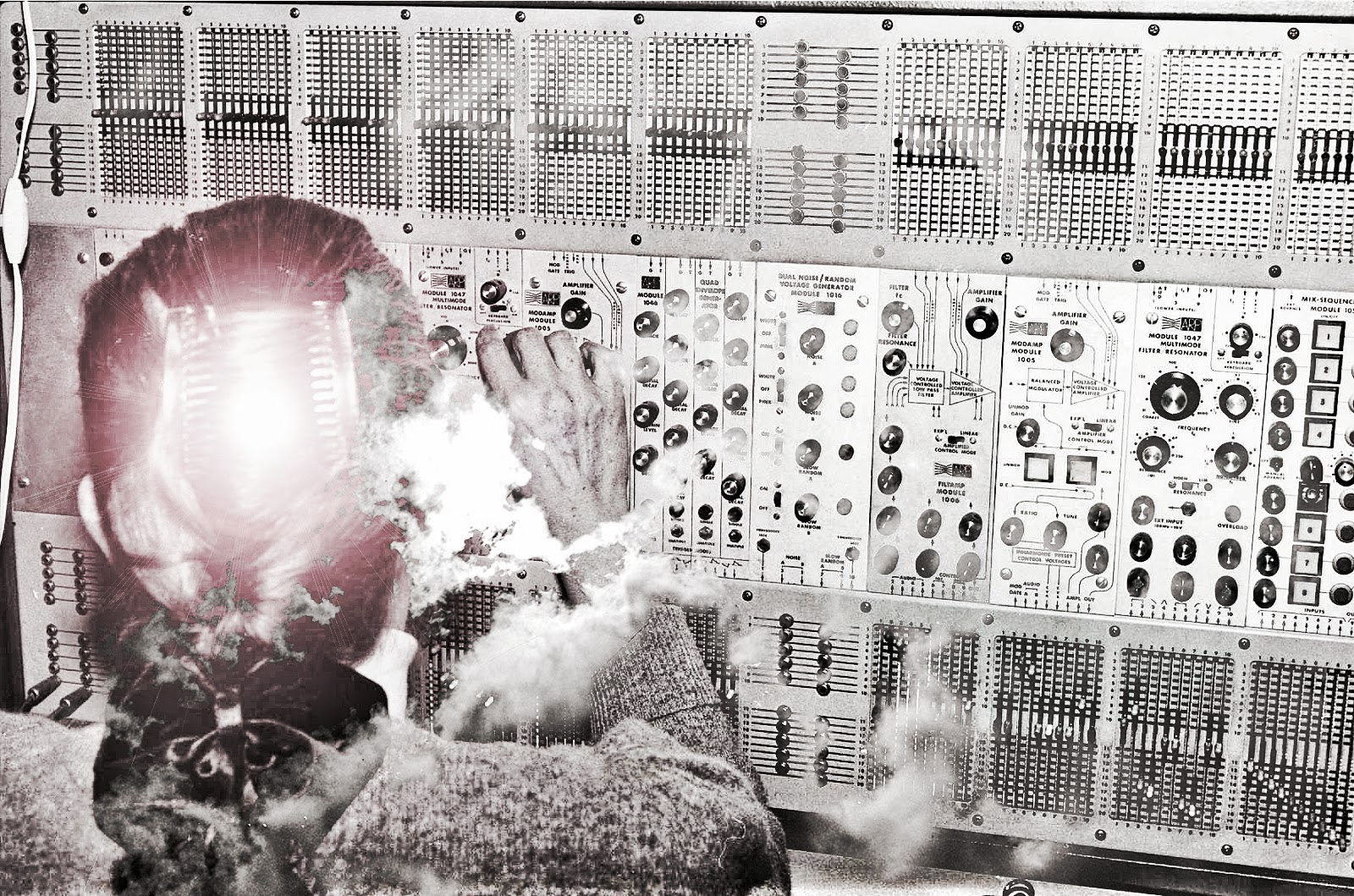
Eliane Radigue - ARP 2500


Interview with Eliane Radigue (December 11, 1980)

This edition of The Morning Concert features Parisian composer Eliane Radigue. Host Charles Amirkhanian explores Radigue’s background as a student of Pierre Schaeffer and Pierre Henry, her compositional technique involving synthesizers and tape recorders, and her life as a composer and Tibetan Buddhist. Radigue discusses the compositional and performing processes involved in her "combinatory" music, and explains how she has adapted to the lack of acceptance of her music in Paris. Radigue performs two pieces live in the studio: Chry-ptus and Triptych. This radio performance constitutes the world premiere of the first and third movements of Triptych.


Radigue's long-term study of Buddhism is reflected in this meditative work - Kyema is exemplary of the composor's interest in synthesized drones. This work is the first piece in the Trilogie de La Mort,a three-part series based on the Bardol-Thodol, the Tibetan Book of the Dead. "Kyema" is a tibeten word referring to the state of surprise mixed with sorrow.


ELIANE RADIGUE was born in Paris, France. She studied electroacoustic music techniques at the Studio d'essai at the RTF, under the direction of Pierre Schaeffer and Pierre Henry (1957-58). She was married to the artist, Arman, and devoted ten years to the education of three children, deepening classical music studies and instrumental practice on the harp and piano at the same time. In 1967-68 she worked again with Pierre Henry, as his assistant at the Studio Apsome.
Radigue worked for a year at the New York University School of the Arts in 1970-71. Her music, its source an Arp synthesizer and medium recording tape, attracted considerable attention for its sensitive, dappled purity. She was in residence at the electronic music studios of the University of Iowa and California Institute of the Arts in 1973.


Becoming a Tibetan Buddhist in 1975, Radigue went into retreat, and stopped composing for a time. When she took up her career again in 1979, she continued to work with the Arp synthesizer which has become her signature. She composed Triptych for the Ballet Théâtre de Nancy (choreography by Douglas Dunn), Adnos II & Adnos III, and began the large-scale cycle of works based on the life of the Tibetan master, Milarepa.
In 1984 Radigue received a "bourse à la creation" from the French Government to compose Songs of Milarepa, and a "commande de l'état" in 1986 for the continuation of the Milarepa cycle with Jetsun Mila.

Notoriously slow and painstaking in her work, Radigue has produced in the last decade or so on average one major work every three years. Very recently, in response to the demands of musicians worldwide, she has begun creating works for specific performers and instruments together with electronics. The first of these was for bass player Kaspar Toeplitz, and more recently the American cellist Charles Curtis.

She currently lives in France, where she continues to compose electronic music and to study the teachings of the Tibetan lamas.


Selected Discography


Songs of Milarepa (single disc) (Lovely Music, 1983)
Jetsun Mila (Lovely Music, 1987)
Kyema, Intermediate States (Experimental Intermedia, 1992)
Mila's Journey Inspired by a Dream (Lovely Music, 1992)
Biogenesis (Metamkine, 1996)
Trilogie de la Mort (Experimental Intermedia, 1998)
Songs of Milarepa (two discs) (Lovely Music, 1998)
E = A = B = A + B (2 x 7" limited edition) (Yvon Lambert, 1969, Povertech Industries, 2000)
Adnos I-III (Table of the Elements, 2002)
Geelriandre / Arthesis (Fringes Archive, 2003)
Elemental II (Records of Sleaze Art, 2004)
The Lappetites. Before the Libretto (Quecksilber, 2005)
L'île re-sonante (Shiiin, 2005)
Chry-ptus (Schoolmap, 2007)
Naldjorlak for Charles Curtis, (Shiiin, 2008)
Triptych (Important, 2009)
Vice Versa, etc. (Important, 2009)
Jouet Electronique / Elemental I (Alma Marghen, 2010)
Transamorem / Transmortem (Important, 2011)
Feedback Works 1969-1970 (Alma Marghen, 2012)
"Ψ 847" (Oral, 2013)

The triple -CD Trilogie de la Mort includes Kyema, Kailasha and Koume. The two disc Songs of Milarepa includes Mila's Journey Inspired by a Dream .


More Radigue in Prepared Guitar

Wednesday, May 25, 2016

Le Picadilly by Erik Satie (1866-1925) by Ya-Ling Chen


Satie, a French composer, studied music at the Paris Conservatory Schola Cantorum. He was the pupil of Vincent D'Indy and Albert Roussel.


Against the romantic Wagnerian style which was incapable of expressing a French sensibility, Satie developed a controlled, abstract and seemingly simple style. His music, in general, features a removed, unaffected beauty. Although his early works anticipate the harmonic innovations of some impressionists, such as Debussy and Ravel, his later compositions foretell the neoclassicism of the early 20th century.


Satie often disguised his artistic intention with comical humor, adding nonsense programs or whimsical titles such as Three Pieces in the Shape of a Pear (1918). The "avant-garde" in Satie's aesthetics is found not in his often very bland music but in the ways that his compositional simplicity challenged the ultra-seriousness of the musical establishment.


A widely experimental musician, Satie composed a musical score in 1924 for a twenty-two minute avant-garde film entitled ENTR'ACTE, written and produced by Francis Picabia, directed by René Clair. The cast of the short film included Marcel Duchamp, Man Ray and Satie himself.


René Clair (1898-1981)/ Erik Satie (1866-1925) Entr'Acte (1924)

It was the first time a "shot-by-shot" musical composition had been written for a film. Satie meticulously examined the film and wrote a composition designed to synchronize exactly with it and to have rhythms match the flow of the editing of the film. It is certain that none of the artists involved in the film were interested in providing the audience something that was expected. (They used an element of pleasant rather than unpleasant surprise.) The music of Satie was recorded by Henri Sauguet and added to the silent print in 1967.


 The Cinematic Orchestra - 'Entr'acte'


The music playing here is cited from SATIE/ 3Gymnopédies & Other Piano Works, 1984, no. 17 - Le Picadilly. Beginning in 1888, Satie was a pianist in a number of Montmartre cafés (which were the meeting places of musicians as well as of writers and painters.) Around 1900, he produced several first-rate café songs. Le Picadilly is one of the music-hall pieces composed during this period. Satie's contribution to the world of popular entertainment was substantial.


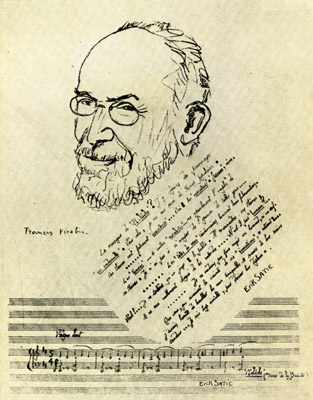
Erik Satie by Francis Picabia

It is hard for us now to imagine how astonished the Paris audience must have been with Satie's music which was so different from the lush compositions of his peers, Franck and Saint-Saens. Satie's audience must have been especially astonished when the music they heard was accompanied by the composer's bizarre titles and performance instructions. Yet Satie's compositions are still unlike anything else in the piano literature and still full of touching and evocative delight and charm.


MORE in PREPARED GUITAR

Sound Aesthetics: Xenakis (January 7, 2016)
Pinhas Deleuze Sound language (January 21, 2016)
Angle(s) VI John Cage (April 30, 2015)
Morton Feldman (March 16, 2015)
Morton Feldman and painting (October 3, 2014)

Erik Satie: Le Picadilly